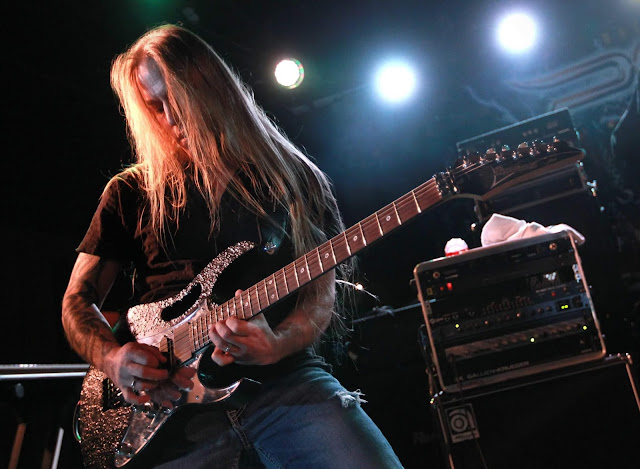
Interview with Guitarist Michael Kelly Smith (Britny Fox/Cinderella)

By Mick Michaels
Cosmick View: Hello, Michael,
and welcome to The Cosmick View. Thanks for taking some time out of
your day to speak with us. It's greatly appreciated.
CV: How’d you find
yourself in music?
MKS: I started playing guitar when I was 14. I had an older, older brother,
Joe, who had an acoustic guitar, and one day I just picked it up and was
curious.
I've seen people play but
never touched a guitar before. I picked it up and figured out a couple things.
And I really kind of liked it.
I thought, okay, this is
something that I want to try. So I, went on to get a cheap acoustic and took
some lessons and it came pretty naturally to me. So then a little while after
that, I convinced my parents to get me a Les Paul guitar back around 1974.
I took some more lessons
from some really advanced teachers in Reading (Pennsylvania) area.
One teacher in particular,
Kenny Baggins, was completely awesome and a huge inspiration and taught me a
ton. He was a great teacher. I was a good student…it was a good match up.
Once I got proficient
enough, I got into a couple garage bands. I always tried to gravitate towards
older guys who were already playing. I thought if I'm around more experienced
people, that's going to push me to get better quicker.
So I got into a couple bands and jammed with everybody that I could.
I started to get better at
playing with the drummer and bass player…and with a full band.
I did that for years,
playing in local clubs and bar bands, and then eventually moved to the
Philadelphia area because I knew that that's where the scene was.
CV: When did you first
meet Tom Keifer?
MKS: I got into a band called Telepath that had a full schedule of playing bars
and clubs, and that's where I really got my experience being on stage in front
of people.
That band lasted for a
couple of years. It was the summer of 1979. We were booked at the Penalty Box
in Wildwood, New Jersey, and that's back when the drinking age was 18. So, you
can imagine the amount of people who would turn out. Plus, there was a thirst
for rock music.
Almost everything back
then was cover bands. Telepath was a cover band.
We played there the entire
summer. 5 or 6 nights a week, two sets a night.
We split the time between
two other bands.
As that summer was coming
to a close, our guitar player, another excellent player, Dave Cullen from
Reading, who went on to win a Grammy and who's like a world-renowned classical
guitarist, said that he was leaving the band at the end of the summer to go
onto college for classical music, specializing in classical guitar. So, we had
an opening for a guitar player.
We auditioned about 7 or 8
people, all of which were very good. And one of the people we auditioned was
Tom Keifer.

CV: What was that first
meeting like? What do you remember?
MKS: This is the end of the summer, 1979. Tom walks in with this small amp and
his Les Paul. He came up and we ran through some Zeppelin and Aerosmith songs,
and I knew immediately after the first couple chords that he was our guy.
We just had a chemistry.
He had been kind of doing
what I had been doing coming up to the club scene.
I said to the band, “This
is our guy.” And they're like, “No, there's three other guys that are better
than him.” I'm like, “well, maybe technically.’ But I said, ‘as far as the
chemistry, he's our guy.”
The band didn't want him,
and I insisted. I said, “He's absolutely the guitar player we need.”
I finally won the
argument. Tom joined the band and we became best friends.
From that point we started
playing South Jersey and the Philadelphia club scene.
CV: But like with most
band situations, nothing is forever. Where did you find things going at this
point?
MKS: Tom and I were in Telepath. But the band had splintered. I had a band
called Psychopath. Tom went on to do a band called Diamonds.
Then at one point, I had
an offer to join the Priscilla Harriet band. She was a girl singer from North
Jersey who was opening for Twisted Sister at the time. Saw it as an opportunity
to get out of the Philly and South Jersey area.
Tom and I ended up getting
back together to join the Priscilla Harry band and Eric Brittingham was on bass
and it was the drummer from the band Diamond.
With Priscilla Harriet, we
did the whole North Jersey club scene for maybe six months, only to realize
that there was no money in it and we were playing covers.
We were a good cover band
playing AC/DC, Scorpions, Black Sabbath…heavy rock, even some Plasmatics
because we had the girl singer… all kinds of great stuff. But it was going
nowhere. We saw that there was no future in doing covers…and we didn’t want to
be just doing that forever.
That’s when I said to Tom,
we should start an original band. Tom had some ideas and was starting to become
a songwriter. Tom was starting to write some original music. Just shortly
before that we had opened for Twisted Sister. So that gave me the idea that if
they're doing it, why can't we? That's when I said to Tom, ‘you know, we should
start an original band.’
So, Tom and I, with Eric
(on bass), got together with my friend Tony Dystra (on drums) who I knew for
years. I used to go see him play in a band called Enforcer…they were
phenomenal. I called him and said, ‘Hey, I have a band that's starting up all
originals.’
Tony, Eric and Tom and I got into a room to rehearse, and the first night it was like perfect chemistry. We had like three songs completed on our first time we ever played together…. And that became Cinderella.
The Dead End Kids, back
then, had a handful of originals that they would throw in with their covers. A
few other bands did that, but we were the first band that I recall that
actually came out as a full original band.
It all came together. Next
thing you know, we're packing the Galaxy and the Empire Rock Club and
eventually that led to the record deal.
Larry Mazer was our managing manager. We shopped our demos around to every label multiple times and got turned down by everyone multiple times. Not because they didn't think the band was good or the songs weren't good. We kept getting the same no thank you letter because they thought we sounded too much like Aerosmith and AC/DC.
It finally came down to
PolyGram Records, who offered the band a deal. However, they had a different
vision for the band and said, ‘Yeah, we'll sign the band, Tom and Eric…but we
want a new a guitar player and a drummer.”
That kind of was the end
of the road for Tony and I.
There was no reason for
it, really, other than the guy who signed the band, held all the cards and
called the shots. It was the last hope for the band to get a record deal. It
put Tom and Eric in a bad position because they didn't want to break the band up
or get new players, but it was a matter of a record deal or fire Tony and I.
So, we were fired. Cinderella went on to do what they did. Tony and I were
devastated.
CV: Such a situation would
easily cause anyone to say forget. But you didn't choose that path.
MKS: We eventually
regrouped.
That's when I got a call
from Dean (Davidson). Dean used to come watch Cinderella all the time. He used
to be a drummer in the band World War III.
He decided he wanted to be
a frontman, lead singer, guitar player like Tom, He used to stand at the side
of the stage and watch everything we did for a couple of years. So he decided
he wanted to be the next Tom Keifer.

That was the beginning of Britny Fox.
CV: How did you find
previously being in Cinderella affect what was happening with Britny Fox? Was
there some crossover to be had?
MKS: We started playing the South Jersey Philly area and the door was
already kind of open because of Cinderella. So it didn't take us long at all to
start drawing big crowds and getting label and interest. And we were on the
verge of signing to a new label. We had a record, a record label offer…we were
excited.
The showcase that we did
for that label was the night Tony was killed in a car accident. There were lots
of highs and lows through this period.
We lost Tony. But we
pressed on and brought in drummer Adam Ferrailoi (aka Adam West).

We kept going. We did more
demos, shopped them around, and eventually ended up signing to Columbia
Records.
Ironically, that came to
be after a showcase that we did for Columbia opening for Cinderella and
Wildwood, New Jersey at the Convention Center.
I called Tom and said, “Hey,
I kind of need a favor. We needed a gig in front of a lot of people.” I knew
they were playing there. It was good timing. I said, “Can we open for you?” And
he was like, “Sure.” That's when we got signed to Columbia.
Columbia’s A&R guy
then suggested that we might consider a different drummer. Which was a bad deal
for Adam because Adam really helped us out and saved the band at that period of
time. Because of Adam, we were able to keep going with things. But ultimately,
we ended up getting Johnny Dee on drums. Johnny was in Waysted at the time.
CV: The lineup sorted out
and the label on board, what was the reception?
MKS: We put the first album out in 1988, early summer.

First video was “Long Way
to Love.” Video came out and got a pretty good amount of airtime on MTV. Bobby
Doll from Poison saw it and loved the song and the band. They were just about
to go out on their Open Up and Say Ah tour…their first headlining tour. We got
a call from Poison's management asking us if we wanted to be the opening band,
and we're like, of course! That was our first big touring break opening for
Poison on that tour. And then, the “Girlschool” video came out, around maybe
August or so of that year, and that did really well on MTV. It was a top ten
countdown video. And by November, I believe it was, our album had gone gold, so
it was selling really well thanks to MTV and the Poison tour.
From there it was really
starting to pick up steam. Then we toured with Ratt and Joan Jett and things
were going along really well. Then the end of that year, we played in Tokyo,
Japan, opening for Bon Jovi, at a big New Year's Eve gig with Kingdom Come and
Ratt on the bill. That was a highlight. It was like 50,000 people in
attendance, and we were told that 2.5 million people were watching from home
because it was a live telecast in Japan. The stage was huge. At that point we
were at the top of our game.
CV: With everything
rolling full steam ahead, was the goal at that point to capitalize on the
success with a second album as soon as possible?
MKS: We continued to do more gigs. Then the label wanted us to get back into
the studio to do the second album. We also did the video for “Save the Weak.”
That did well, but not as good as “Long Way to Love” and “Girlschool.”
The first record is still
selling at this point where like 800, almost 900,000 copies sold…on the verge
of platinum. The label wanted us to go back and start on the second album,
which was good, but it was bad in the respect that aside from that Japan gig,
we had not toured Europe or Canada or anywhere else except back and forth
across the US a few times. There were a lot of markets that we didn't hit.
So that was kind of
detrimental in the big picture.

But they wanted us to do a
second album. So, we started on the second album. We had songs left over from
the first time around and wrote a bunch of new songs…went to New York and
recorded Boys and Heat.
And that's when some
tension started to build in the band.
CV: What sort of tension?
What was happening internally at this point?
MKS: Dean wanted to
abandon our original sound to a certain degree and become more like Def
Leppard. And we're like, “Well, not a good idea because we have our own thing
going here. Why don't we just stick to what works.”
We got through making that
record, and it turned out to be a really good, strong second album that wasn't
too far off from the first album.
We toned down the image a
bit. The album came out. It did not do as well as we were hoping for out of the
gate. But then we got an offer to do the Alice Cooper Trash tour in Europe, and
that was huge because we hadn't been to Europe before that. We accepted that,
and that helped us get a lot of sales on the first album and the new album,
Boys and Heat, in Europe.
We were doing well there,
and then we rescheduled to come back to the US. We signed on to do the Kiss Hot
in the Shade tour. Kiss was scheduled to go out and start a US tour, around the
end of February or March, and we were signed on to the tour. We're like,’ oh,
here's our big break. Here's our chance.’ Opening for Kiss was the perfect slot
for us because Kiss fans were going to like Britny Fox. Gene and Paul were big
fans of the band as well, which is why they wanted us on the tour.
We were psyched. But then,
we got a call that they were postponing the tour to a later date because the
Hot in the Shade album wasn't doing as well as they had hoped. They were
struggling getting their videos played on MTV. Then, we were told the tour was
going to get pushed back to April. A little bit after that, we got the call
that we were getting bumped off the bill for Slaughter. Slaughter’s first album
came out and went through the roof… tons of MTV play heavy rotation. They had
like 1 or 2 million records sold, overnight. And our second album, Boys and
Heat, was nowhere near that. From a business standpoint, Gene and Paul made the
decision based on what they needed…the biggest band they could get to sell more
tickets. Understandably so. I can't blame them, but it was a big blow to us to
lose that tour. And that's when Dean got really annoyed and disenfranchised
with the whole thing. Behind our backs he went and started Black Eyed Susan.
We had a ton of dates
booked, really well-paying gigs…like 4 or 5-months worth of gigs coming up
after we found out the Kiss thing fell through. We had just started that run of
shows, and Dean
quit the band.
He just freaked out and
quit. Which was the end of that era of Britny Fox.
We were unemployed. No
singer. We put the word out for singer. Unfortunately, it took a year to find
Tommy Paris.
During that time, Columbia
got tired of waiting. We were dropped from Columbia.
CV: What was the band's
mindset...was there still a drive to go on?
MKS: For a time there, we had no label, no singer.
But we persevered and kept
going. We thought, "We'll find a new singer and find a new label,"
which we did. We found Tommy Paris. Did demos and shopped them around and ended
up signing to East West Atlantic Records. East West was a subsidiary of
Atlantic and we did the Bite Down Hard album.
CV: How did you feel the
album was received?
MKS: It was a great album, but we were up against the challenge of having a
new singer and the Seattle and grunge scene was kind of taking over at that
time.

The album came out in ‘91
and was completely overlooked… as was all hair metal at the time, pretty much…with
a few exceptions, some bands like Skid Row and Bon Jovi still did well through
the early 90s, but we were not one of them because we had a new label and we
had a new singer, so we kind of lost all that momentum that we had. It was kind
of the beginning of the end.
There we were…a great new
album with a great singer. The album was great. Really. And the people that
knew about it loved it. Some were not as accepting because we had a new singer.
Years later a lot of people have said it's their favorite Britny Fox album. But
either way, it fell through the cracks…didn't do anything.
We toured on that album.
Didn't have a large turnout because of the timing. The fact that we had
disappeared for so long totally killed our momentum that we had with Dean.
But we kept trying. We did
our best.
CV: The Bite Down Hard
line up found itself regrouping in the new millennia. Tell us a little about
that.
MKS: Fast forward to the year 2000. We were offered a record deal with
Spitfire Records to do a live album and a new studio record.
We regrouped and recorded
a bunch of shows, and that ended up being A Long Way to Live. Our first live
album.
We had hoped to be able to
do a live album with Dean, but, Dean quit, so that never happened,
unfortunately. We could have done a really great live album with him. But we do
our live album with Tommy. Long Way to Live had great critical acclaim. The few
that knew about it loved it. And it was a great live album.

But sales weren't great
and it fell through the cracks.
We had an obligation with
Spitfire to do a new studio record. At this point, the band's pretty much
falling apart. We were living in different places. We ended up piecing together
material for what became Springhead Motor Shark.
Tommy and I wrote half of
it, and Bill and Tommy wrote the other half give or take.
It was experimental. We
weren't trying to stay in the same mode that the first three albums were in. We
weren't trying not to either, but it was just the material we had…it was more
diversified. We thought, why not go with it. We had nothing to lose at that
point. Our fan base primarily was gone anyway.
I love the album.
Certainly, most Fox fans did not like it because it was so different from what
they were used to from Britny Fox.
So that album came out and
had good reviews and a lot of people loved it for the reason that it was so
different. But most Britny Fox fans were like, ‘Nah, that's too different for
us.’ Another fell through the cracks again.
We never toured on that
record. Just put the brakes on everything.
The band continued to go
out and play, without me involved, with different guitar players and then
eventually with different singers and then different drummers.

It just became a mess. And
that's where we are today. Now there's a version of the band out playing with
zero original members.
CV: Do you think a time like the 80s will happen again?
MKS: It never will. It can't because, well, nothing really does. It's
like Woodstock. That's not gonna happen again.
CV: Let's go back again to
the beginning...those early years. Did you want to play covers? Did you have a
choice?
MKS: It was just like what
everybody did…everybody was in a cover band.
CV: For you, when first
starting out in bands, was doing original music even talked about?
MKS: No, not back then. Your whole mindset was what's the best cover band I can get
into or start? And how can we get booked? And how can we make 200 bucks a
night? Then, how can we make 300 at night?
There's always that in the
back of your mind…you're always thinking, well, someday I want to be in a real
band. Thinking, yeah, someday we'll get there. But at the time, it was all
about playing the most popular cover songs.
CV: What types of cover
songs were you playing at the time?
MKS: Every cover band I was and always played slightly heavier stuff…everything
from Foghat to Golden Earring, Grand Funk, ZZ Top, Nazareth, Slade, AC/DC,
Montrose, Aerosmith and Zeppelin. Which was good because that's how you learn
how to play. You get better when you learn how to play all the great stuff.
When Tom and I got
together and we started doing the originals, him and I both had all that
experience of doing all those cover songs for years. So that's the kind of chemistry
that we had and it really helped.

CV: What was it like writing with Tom
Keifer in those early years?
MKS: When it came to the
originals song ideas just came together like seamlessly. It was easy. That was
the easy part, putting the songs together.
It’s weird because all the
originals had bits and pieces of the covers. We took little pieces of all these
different influences. In my playing alone, I loved Michael Schenker, Ace
Frehley and Ronnie Montrose…Rod Price from Foghat, Mick Ronson, Angus Young.
So, you take all these different styles and you try to create your own style,
which is easier said than done. But if you put your mind to it, you keep
everything in the back of your mind…all the stuff you've played for the last
ten years in clubs.
When it came time for the
originals, we knew kind of generally what the sound was going to be. All the
Cinderella and Britny Fox songs, they were right out of the same mold as
Aerosmith, AC/DC, and Kiss. It was like a no brainer. It was kind of a
blend of all that stuff that just came naturally.
People say like, oh, that
song reminded me of so-and-so, or that song reminded me of this band. And
everybody's perspective is different. We thought we sounded like Aerosmith,
Kiss and AC/DC, which was the criticism from the labels. That’s what we were going
for. That's the music we liked. Those were the bands we grew up with, and
that's what we ended up sounding like as far as the original band.

Then Britny Fox, same
thing. Although with Britny Fox, Dean kind of wanted to be Tom, which is all
well and good because we were from Philly. It probably was a benefit that Dean
sounded a little like Tom. And his songwriting was a lot like Tom's, deliberately.
And then we had Tony, Bill and me. I mean, half of Britny Fox was half of
Cinderella. So you could not help but to sound similar…which was a good thing.
CV: Did you find being in
Cinderella, even though being let go upon a label signing, did have some
benefit when Britny Fox came along?
MKS: The whole Cinderella thing had opened the doors and it made it a lot
easier for Britny Fox to make that step into getting a record deal and getting
recognition and getting noticed. The almost four years I spent in Cinderella
really helped pave the way for Britny Fox.
CV: Cinderella was
definitely an organic process from the ground up. But with Britny Fox, there
was already a model to follow. Did you see that at the time?
MKS: Cinderella was completely organic because we were like the first band
on the scene, South Jersey and Philly, to come out with an image and a sound
and all original music. We kind of made that the thing that everybody aspired
to do. Next thing you know, there were 10 or 15 or 20 other bands. And all of a
sudden, they're all original bands, and all of a sudden, they look a lot like
Cinderella…these copycat bands. But copycat stuff usually doesn't work.
With Cinderella, we developed that whole image. The name
of the band was my idea. The thought behind that was why not have a name that's
really the last thing you would expect for a band that sounded like that…Cinderella.
Who's going to call their rock band that?
At first people were like,
“What the hell is with that name?” But then once they saw us, they're like, “Okay,
well, that's Cinderella.” Then it just becomes what they associate the band and
the music with. So that worked.
Dean had the name Britny
Fox, which is a cool name because names are important. And we were trying to
follow in the same footsteps as Cinderella to a degree. Again, couldn't help it
because, like I said, half of Britny Fox started out as half of the original
Cinderella. It was kind of just a natural progression.
CV: Did you want to
include covers with Cinderella and Britny Fox, especially to have more options
for venues to perform at?
MKS: We kind of just ignored the covers. With venues, if they don't want us
we don't want them. We just focused on the Galaxy and the Empire Rock club. Our
foothold was South Jersey and Northeast Philly. We rehearsed and did demos. And
we got such a huge following, quickly, that our goal wasn't to infiltrate the
cover circuit at all. We were, at that point, just done with that. That's a
dead-end street for us. We had our sights set on national and worldwide
recognition. We wanted a record deal. We wanted our music released worldwide
and do it for real. And that's what ended up happening, with both Cinderella
and Britny Fox. Fortunately.
CV: Did you feel like you
could make it big being a Philly band, without going to New York or L.A.?
MKS: Oh, absolutely. Absolutely. We felt that if you're good at what you do
and we really believed that, both in Cinderella and Britny Fox. If you're good
at what you do, it doesn't really matter where you're from. We also noticed
that the whole L.A. thing was getting oversaturated with all the bands that
came off the Sunset Strip.
Yeah, we could have gone
out there and competed and done well and probably could have gotten signed out
there too. But we lived here, living in the Philly area. Our sights were set on
bigger things. We weren't trying to be the biggest band in Philly…that wasn't
our main goal. We wanted to be the biggest band everywhere. We lived here. So
that's where we did our whole thing. It was never a question of, “Oh, we have
to go to L.A. to get a record deal.” Never crossed our minds. We're like, “Look,
we're good. We can get a deal and we can make this happen right from Philly.”
CV: Why do you think the
80s were so significant especially when it came to the music?
MKS: The heavy metal hard rock thing was really picking up steam toward the
mid-80s. It was really just good timing because there was such an appetite for
that style of music and people back then would go out and see live music. They
still had the interest to go out into the world and experience something going
on beyond their living room or bedroom.
We were fortunate. It was
good timing. There were people going out to clubs and then once we started to
get a foothold, as an original band, it became more acceptable. “Okay, well,
they played their own music, but it's really good. So, we don't need to hear
Eddie Money covers anymore.”
CV: How did MTV and other
visual mediums play into the band’s development?
MKS: We knew we were a visual band, and we knew we had a good live show. So,
we knew automatically that if we got a deal and got a record out and made
videos, that would flow perfectly.
We knew that videos would
be our thing because of the image of the band. That goes for Cinderella and
Britny Fox. It really was the thing.
CV: There is still a lot
of debate about what actually happened when the Hair Metal scene came tumbling
down. What was your perspective?
MKS: For both Cinderella and Britney Fox, both bands got pigeonholed into
the glam hair metal category, which you can't help because that's what it was…Poison,
Rat, Quiet Riot, Cinderella, Britny Fox. It was hair metal, so you couldn't get
away from that.
The downside was, as time
went on that whole market got flooded with bands of that genre that were really
not good at all…decent at best…and some of them quite poor. So, the market got
oversaturated with a lot of copycat bands because labels were signing up every
L.A. strip band there was…whether they could play or not or write a song or
not.
If they had a glam image, then sign them up… put a record
out, and hope, with fingers crossed, that they've get a song on a radio station
somewhere, or get a video on MTV. And some did, but it got so oversaturated
that it almost became a parody. Which was very unfortunate because all those bands that
were copycat bands ruined it for the good bands of the genre.
CV: How did that
mindset affect what you were doing?
MKS: So once people got tired of it, all of it
went down the drain. And they kind of took us down with them. To be honest, Tom
Keifer, after Cinderella ran its course, went out solo. He was able to conform
and get beyond that (glam) label because he did something different. Britny
Fox, not so much.

CV: How was Britny Fox as
a band handling all these changes in the music industry during that early 90s
period?
MKS: After losing Dean and then when Tommy came in, we were no longer really
a glam band at all. Like the image kind of disappeared. And that was also a
downfall because we were known for looking different and being a little bit
over the top, not quite over the top like Poison was, but little over the top
on the first album.
Then we scaled back image
wise on the second album, which everybody was doing at the time. Just a natural
progression of how it all kind of worked because everybody else is watching
everything that everyone else is doing, and then it's kind of like, who's going
to jump on which bandwagon?
We weren't ever interested
in jumping on bandwagons, but Dean was because after Boys he decided he wanted
to be the Black Crowes. Absurd because he was the lead singer in Britny Fox. Between
the two albums, we sold well over a million records.
CV: What was the feeling
like following your departure from Cinderella and seeing the band’s immediate
success?
MKS: I'm working in a record store for $5 an hour selling Cinderella
records, trying to get Britny Fox going. That was a kick in the teeth. Like,
wow, there's my band (Cinderella) selling millions of records, and I'm putting
up Cinderella posters in a record store.
But it kept me motivated
to prove myself. I was fired from Cinderella, but for no good reason. So that's
where Britny Fox gave me the opportunity to prove that. I could compete and I
would. I was good at what I did.
CV: When did you notice
the shift in the music industry?
MKS: It wasn't until we
were writing material for Bite Down Hard that we started noticing on MTV, the
shift. When Nirvana hit, you could tell right away that the whole thing was
changing. You could just tell there was a shift and they were phasing out all
the hair metal stuff.
I think it just got so
overdone that there needed to be a change.
Everybody's of the popular
belief that grunge killed hair metal. I've always said that hair metal killed
hair metal. In a certain way, it kind of killed itself because it's got so bad
that it had to end. But when that happened, it took all the good bands down
with it. Bands like Cinderella and Britny Fox, who I thought were amongst the
best of those style bands, unfortunately, got pushed aside with all the not so
good stuff.
CV: Tell us the story of
how you came to connect with Gene Simmons of Kiss.
MKS: Back in the very beginning of what became Cinderella, after I convinced
Tom that we should start an original band and that the cover thing wasn't going
to lead anywhere… except for playing covers forever, I think Tom and I did a
three song demo of the first three songs that Tom wrote. That did not include
Tony or Eric. We had a friend who played drums and a friend who played bass. We just wanted to
get in the studio and get a feel for what we could do.
It was right around that
time that I had read that Ace Frehley was leaving Kiss. I had grown up with
Kiss and played Ace Frehley. I played a lot like him.
So, just on a whim, I sent
a bunch of pictures and a tape of myself playing to Glickman and Marks, which
was Kiss's management at the time, and this was before the internet or
anything. I dug until I found out who their management company was in New York.
I said to Tom, “Hey, just
for the hell of it, I'm going to send a tape and pictures to their management
and see what happens.” And he's like, “Sure, go for it.” We're doing our thing.
But he was all for it.
You think at the time
that's a 1 in 1,000,000 chance anyway. But I always believed in what I could
do. So, I sent my pictures and a tape to Glickman and Marks Management. And
about a week or two later, I'm working at a Listening Booth, a record store in King
of Prussia, PA, and I got a phone call from Gene Simmons. And I'm like, wow,
how cool is this?
“I got your tape and your
pictures and we like your image and we like you're playing.” And he said,
“We're planning on having auditions, and Ace's leaving.” He clarified that he
said Ace was leaving and they're going to be having auditions in a couple of
weeks. He say, “Would you be interested in coming up to audition?” I was like,
of course. Yeah, for sure! I'm thrilled. I mean I’m working at the record store
and on the phone with Gene Simmons.
So I went back to Tom and
said, “Tom, you will never believe this, but Gene Simmons called me and said,
they might have me up for an audition.” And he was like, “Cool. That's
awesome.”
At the time, I was more of the lead guitar player between
the two of us. Tom could play; he was good. But I guess I was always more the
lead guitar player maybe in the beginning…in the cover bands.
As time went on, we started taking turns and he was getting
really good at soloing himself. We kind of became a guitar team and would
switch back and forth. So, we were both lead guitar players.
I had the idea to send my tape to Kiss, thinking I probably
wouldn't hear anything, but I wasn't shocked either when I did, because my
playing style was a lot like Ace’s.
But in the meantime, Tom and I just kept our focus on
starting Cinderella.
Then another week or two goes by and I get another call from Gene, and he said, ’Listen, turns out we're not auditioning. We've decided to just go with this guy Vinnie for time constraint reasons.’ He was just a guy that they knew, and they were writing songs with and had done demos with him.
They didn't want to go
through the whole process of auditioning 100 guitar players.
Gene was very businesslike
and very nice about it and said, “We'll keep in touch.” And I'm like, ‘Well,
thanks for the heads up and thanks.’
So I came away with
thinking to myself, “Wow, there's a major connection. That could come in handy
down the road.” Which it did.
I went back to Tom and
said, “hey, you know, they're going with this guy Vinnie. I didn't get to go up
and audition.”
He said, “Okay, well, that
that's a drag. But let's just keep going on this Cinderella thing,” which we
did.
CV: But that wasn’t your
last meeting with Gene was it?
MKS: We did all these Cinderella demos, over 30 songs over the course of like a
year. The first batch of songs, which included Nobody's Fool and Shake Me and,
almost everything on the first album, we did the demos and they turned out
really good. High energy and production was decent for 16 track.
I thought, well, here's
the opportunity to take advantage of that Gene Simmons contact.
So, I called Gene and said
I have a new band. It's called Cinderella. We have demos. Can I send them? And
he said, ‘Sure.’ So I sent him all the Cinderella demos and he loved them. He
said, “I love the songs. I love the name of the band,” the whole nine yards. He
invited us up to his apartment in New York. We rented a limo because we
thought, this is our big chance to get something going.
Rented a limo, went up to
New York. Met with Gene at his apartment, and we sat down. And there's a
hundred variations of the story because stories get twisted as they go. I was
there, so I know the real story.
So, we're sitting down in
Gene's apartment at his table. He has the cassette in front of him, his
notebook with all of our songs. He had notes for each song. About what he
liked. What he suggested here and there or whatever. But overall, he just
thought we were ready for a record deal.
There are stories out
there saying that he wanted to write songs for us, and his songs sucked.
There are a hundred
different wrong stories. I don't know how these things came about…people make
shit up. The fact is, he loved the band.
And he said, “Listen, I'm
going to take you to PolyGram because that's the label Kiss is on.” He said,
“I'm going to take you to our label and try to get you a deal.” He said, ‘It
shouldn't be hard.” So he did. He went to the A&R guy, Derek Shulman, who
was Bon Jovi's A&R guy. That's who ended up with the demos.
Gene called again and
said, “I got the ball rolling.” That was the first foot in the door for
Cinderella getting a record deal. Contrary to other stories that you may have
heard.
CV: So how does Jon Bon
Jovi play into this story of getting Cinderella signed?
We were still playing at
the Galaxy, like almost every week. And that was when Jon Bon Jovi was
recording the second album, 7800°F, on Delaware Avenue in South Philly. This is
after the whole Gene thing…just a few weeks after.
So, the Bon Jovi gang got
finished their sessions and I guess they were looking for something to do when
somebody at the studio said, “There's this really cool band, Cinderella,
playing across the bridge at the Galaxy Club in South Jersey…Voorhees, New
Jersey.”
Bon Jovi knew the club
because his band's years and years before had played there. That's where
everybody says Bon Jovi came out of the Galaxy too. Well, yes and no. I mean,
he was in a cover band or something that played there once or twice. It wasn't
like Cinderella and Britny Fox. You know how the stories get twisted, to sound
better.
So Bon Jovi came over to
the Galaxy, saw our set, came up to the dressing room afterwards and was like,
“You guys are awesome. I'm going to go back to my A&R guy at PolyGram and
pitch you guys and try to get you a deal.”
So, we're thinking, “Wow,
now we have Gene Simmons and Bon Jovi.” And Bon Jovi wasn't that huge at the
time. This was only during the recording of their second album, but he had some
clout.
We thought, okay, well,
this is a pretty good situation that we're in because we have Gene Simmons and
Bon Jovi now going to the same label saying, you got to sign these guys saying,
“They're really good. They're great live, they have great songs.” And that
pushed it over the edge.
So about a week later,
maybe not even, we got the call that Derek Shulman was coming down to the
Galaxy to see the band based on Gene Simmons and Bon Jovi's recommendations.
What was he going to do, say, “I'm not interested. I don't want to check these
guys out.’ No, he was like, ’What the hell's all the hype about?”
He came down to see us and
was blown away. He knew the songs were great. We had the place packed. We were
good.
After the show, he was
like, “Yeah, good job… you guys sound great!”
So we thought, wow, we're
pretty much heading in the right direction here. It looks like we could get
ourselves a deal with PolyGram, which ended up happening.
Shortly thereafter is when
Derek offered the band a deal. It was kind of a spec deal actually. It wasn't
like a full out record deal right off the bat. It was like a six-month spec
deal to pay for some more demos.
But he said his vision was
that the band should have a new drummer and a new guitar player. That's when
Tony and I were fired.
That's when Cinderella got
signed to PolyGram and we were replaced and the rest is history.
I'm here to set the record
straight that the first introduction of Cinderella to PolyGram was through Gene
Simmons, which came through me because of my initial contact with Gene. And
then I went back to him after the Cinderella demos were ready. So that got our
foot in the door. Bon Jovi came in shortly thereafter with the second foot
through the door and that's what led to the record deal. And that's the
official story coming from the horse's mouth.
Gene was professional. He
was totally cool. He loved the band. He loved our songs.
CV: What do you remember
most about being the Philly music scene back in the day?
MKS: The fact that there were a decent amount of venues to play, that was
huge. Because without places to play, you could never get a following and get
noticed.
The scene gave you places
to play and get good at what you were doing. The bands that got good were the
bands who played covers for years. That's how you learn. That's how you put it
all together.
So the fact that there was
a music scene for a long time. It was first the cover scene…again instrumental
and beneficial that you had places to play.
You could almost make a
living between your day job and playing four nights a week in a bar or club
somewhere. It gave you that experience that you needed. And then when
Cinderella came along and reintroduced the area to ‘Wow, look what a fully
original band can do.’ Things evolved. Luckily, the timing was good that places
like the Galaxy and like the Empire, that weren't strictly cover clubs for bands
or just bars. We were able to get our following in that way.
But what I remember most
was that there was an audience. People would come out to see bands, first all
the cover bands, and then starting with Cinderella, all the original bands.
That was the biggest thing. We were lucky because trying to do that now…forget
it. Where are you going to play? Who cares? Nobody goes out. Nobody does
anything. So we came along at the right time.
It was a good time. It was
the perfect opportunity in that we could play all these different places, even
though we didn't travel too far out of the Philly-South Jersey area. But there
were enough places to showcase our bands and go out there in front of people
who were still going out to see bands, and that was huge.
CV: As an artist, what
some memories that you still have a special place for?
MKS: The most vivid
memories and most important ones for me were the beginning of Cinderella,
because we were out to prove something. We were taking a chance by being
original. And when we started to pack the Galaxy and the Empire, it's like the
writing was on the wall…we were on to something. So that was the biggest thing
for me. There are thousands of them, but that was huge.
We were drawing all these
people constantly, almost every week we were packing wherever we played.
CV: Do you have a similar
vivid memory with Britny Fox?
MKS: Another milestone was when Britny Fox opened for Cinderella at the convention
Wildwood Boardwalk Convention Center. That was huge because it was a sold-out
show. All the Cinderella fans were there who knew Britny Fox because we came up
through the same scene. Everybody knew the connection…like how Britny Fox was
born out of Cinderella.
We had a huge fan base
right in that audience. Everyone was there to see Cinderella, of course, but
they were there to see us, too. And we held our own. We did great. We got
signed from that gig. That was a huge memory.
We even played teen nights
on Sundays at the Empire. And that was cool. They were loud. That was awesome
because that new, younger audience could be exposed and got to see a band like
us. That was also huge. Again, all timing.
The timing couldn't have
been better coming up to the Philly rock scene than it was for us in the
mid-80s, because of the crowds and the people…the enthusiasm people had for
that kind of music and the venues that would have us play. It was huge.

CV: What has music meant
to you?
MKS: Music's been my
profession. I love music. I remember as a young kid loving pop music on the
radio…there was always something about music in general that struck me and kind
of drew me in.
As a young teenager, my
aspirations were to become a racecar driver. I was big into stock car racing.
But I went from wanting to be a stock car driver to wanting to play guitar in a
band, because I had a friend in high school named George. He was like the first
kid in school with long hair and the first kid who played guitar. He was two
years ahead of me. We lived right down the street from each other, and we
became friends.
He got a guitar and learned
how to play. And the next thing I know, he's in a garage band. So I would go
watch him rehearse and I was just like, ‘Wow, six months ago, he just picked up
a guitar and now he's playing Grand Funk and Black Sabbath, and Aerosmith.’ I'm
like, ’Can you show me how to do that?’
So he showed me a little
bit. I had already had my acoustic lessons. So I was already kind of getting
interested. But that put me over the top when he started playing in a garage
band. Then I had to get the Les Paul just like his…a Gibson amp, a wah wah pedal,
and had to learn all the songs he learned. Like Alice Cooper. I remember
learning all the Alice Cooper stuff.
CV: Did you have anything
to do with the recent Britny Fox tribute recordings?
MKS: No, not at all.
One of the many guitar
players, Tommy Crash, who was doing the live Britny Fox shows during the
2000, is a huge Britny Fox fan. So he just wanted to do a tribute to
Britny Fox.
I think this is the second
one he did. He and his buddies recorded a bunch of Britny Fox songs. And
from what I understand, Bill played on a few songs and Tommy Paris might have
had something to do with it as well.
I was not aware of it
until it was finished. And it wasn’t half bad. I must say, it's kind of
cool when somebody wants to do a tribute to your band and cover your songs. I
took it as a compliment.
CV: Thanks again for
taking the time to share with our readers. We wish you all the best and
continued success.
MKS: Thank you
SPECIAL EVENT
Michael Kelly Smith's "Veterans Rock" Veterans Benefit...."Meet &
Greet" and "Record Show!" 💥 Saturday May 30th 11:00 to 6:00 Parkesburg,
PA VFW Post 4480 👍🦊🍏💥 All proceeds benefit Veterans and their
families! 🤩 $5 general admission...Free admission to all Vets! 🤩Food
& Drinks! 💥 Raffles.... including 2 guitar and amp raffles, a 50/50
raffle + more! 🤩 Michael Kelly Smith (co-founder and lead guitarist of
Britny Fox & Cinderella) Jam session, meet and greet, and Q&A!
🦊🍏 Plus Exclusive and Vintage merchandise! 💥 Hope to see you
there!🤞🍀🍀 Thanks for your support! 👽👽👽 Rock On!
Check out Michael Kelly Smith at:
MKS Facebook: https://www.facebook.com/michaelkellysmithmusic/
MKS Guitars: https://www.mksguitars.com/
Britny Fox OFP: https://www.facebook.com/search/top/?q=britny%20fox%20ofp
Where the stars always shine bright
www.thecosmickview.com
www.facebook.com/TheCosmickView
www.thecosmickvoice.com
www.anchor.fm/the-cosmick-voice


Want to see your logo here? Contact The Cosmick View for details and rates.




Comments
Post a Comment